

HAZMAT NATION
Tunnel Vision and Gas Migration…A Potentially Dangerous Combination
It’s 8:00 a.m. on a Friday morning. Your engine company has just been dispatched to another “routine” gas leak call. Initial reports indicate another case of a directional drill crew installing fiber optic cable hitting a natural gas line resulting in a leak. The local distribution company will get there quickly and have it isolated in no time…just like last time.
Upon arrival on scene, indeed you observe a directional drill operation that has struck a natural gas line. Based on the sound and volume being released from the damaged line, your initial impression is that a natural gas main has been damaged. You request dispatch to notify the local distribution company to respond. You isolate the area and attempt to eliminate ignition sources (including your apparatus). What now?
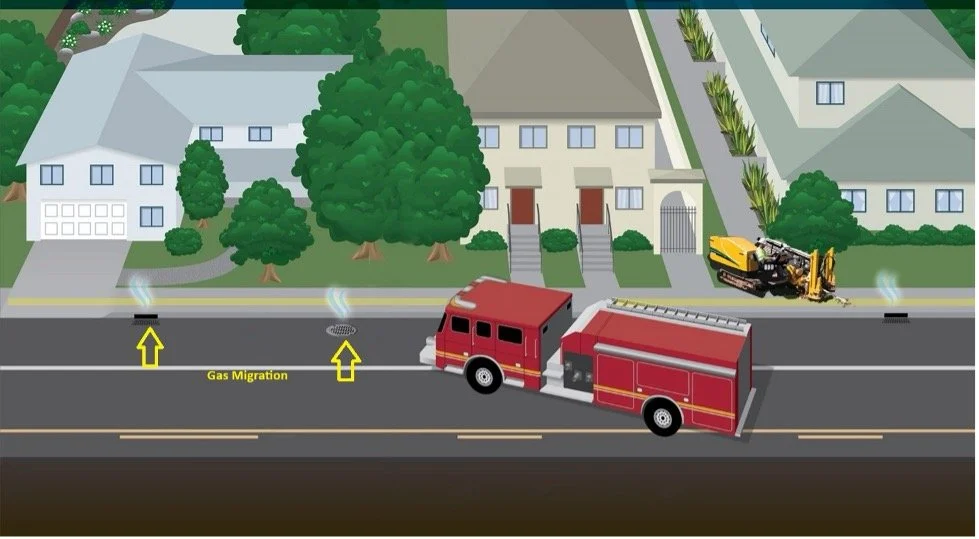
This is the point at which the risk of tunnel vision (and complacency) is at the highest. You observed natural gas being released at the site where the bore rig is located, but is that the only location? Gas migration kills. If you research the National Transportation Safety Board’s archive of pipeline accident reports, you’ll find numerous examples of catastrophic incidents that can be directly attributed to gas migration. In far too many cases, we get fixated on the pipeline breach location (tunnel vision) and fail to identify that the natural gas is migrating through the sewer, storm drain, or other voids in the ground. Incident Command is not a spectator sport. You have to be thinking about scenarios that can create a catastrophic incident and steps to take to mitigate them.
At the scene of a natural gas pipeline incident, monitoring should be conducted early and often. Responding natural gas pipeline operations personnel have combustible gas indicators (CGIs) as well as other types of detection including flame packs, and laser units and will be focused on leak origin identification and any potential migration. Unified Command is your best friend and having a pipeline operations representative with you in the Command Post to assist with tactical decision making is a must.
There is no such thing as a “routine” gas emergency. A responder can be burned from the ignited natural gas release from a 5/8-inch service line. Treat every gas emergency as unique and give it the respect and safety focus it deserves.